
O2 Sensor Replacement Cost
The typical O2 sensor replacement cost at a mechanic is $150 to $600 for each sensor, with parts and labor included. Doing it on your own brings the cost down to roughly $20 to $300 for the part itself, based on your car's make and model. What you end up paying comes down mostly to the vehicle you drive and which sensor has gone bad.
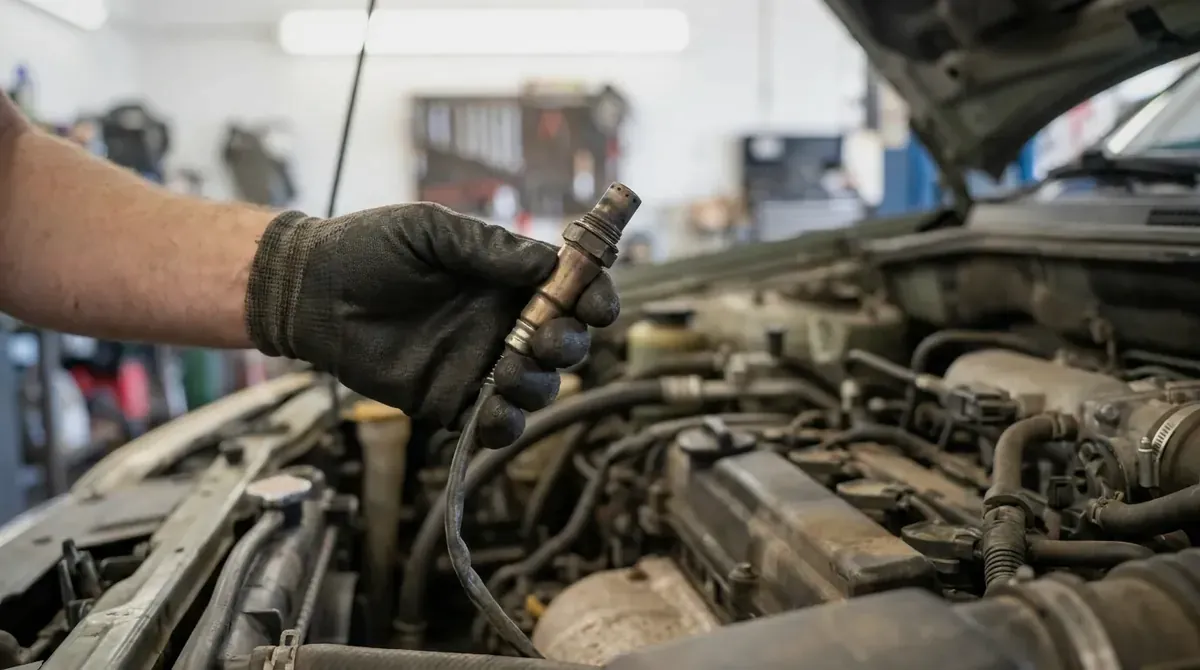
What a shop charges to replace an oxygen sensor
An oxygen sensor is a small component in the exhaust system that tracks how much oxygen remains once the fuel has burned. The engine computer reads that signal and adjusts the amount of fuel it sends into the engine.
Each source collects data from its own mix of shops and vehicles, so their ranges vary a bit. Every figure below reflects having a professional handle the job.
| Outlet | What that amount includes | Typical price range |
|---|---|---|
| AutoZone | A single sensor, with parts and labor | $150–$600 |
| CarParts.com | Having it replaced professionally | $200–$500 |
| RepairPal | What a replacement costs on average | $440–$523 |
| Synchrony, citing RepairPal | What the labor portion runs | $63–$79 |
| Synchrony, citing RepairPal | What the part alone runs | $300–$333 |
In the Synchrony write-up of RepairPal's numbers, most of the bill is the sensor itself, with labor making up the smaller share. Your local shop may quote higher or lower than these averages. When a quote separates the part cost from the labor cost, comparing one shop against another gets easier.
Replacing an oxygen sensor yourself
If you handle it at home, AutoZone figures a do-it-yourself replacement lands at $20 to $300 for each sensor, based on make and model. Blue Ridge Automotive lands in a similar ballpark for just the part, at $50 to $200 per sensor.
You can buy sensors individually. Only the failed one needs replacing, so picking up a complete set is unnecessary.
Oxygen sensor count by car
Depending on the design and engine, a vehicle may carry anywhere from 1 to 4 oxygen sensors. Most newer cars have 2 to 4 of them.
They are positioned on both sides of the catalytic converter, the exhaust component that scrubs harmful gases before they exit through the tailpipe.
- Upstream sensor: positioned ahead of the catalytic converter. It feeds the engine computer the data used to manage the fuel mixture.
- Downstream sensor: positioned behind the catalytic converter. Its main job is to confirm the converter is still doing its job well.
Signs of a failing O2 sensor
When a sensor wears out or goes bad, you tend to notice it in the way the car behaves and how quickly it burns through fuel. Watch for things like:
- the check engine light switching on
- poorer fuel economy, meaning more trips to the pump
- idling roughly or hesitating as you press the gas pedal
- misfires, uneven running, or the engine stalling
- higher emissions coming out of the tailpipe
- a gasoline smell in the exhaust, which a dirty sensor can bring on
Since most oxygen sensors hold up for 60,000 to 90,000 miles, cars with more miles on them are the ones most likely to show these signs.
Will a bad O2 sensor make a car fail an emissions test?
It will. Where testing is required, a failed O2 sensor will generally cause the car to fail its emissions test. As of 2026, 27 states plus Washington, D.C. test vehicles in some or all of their areas.
An OBD test is the method most of these states use. The testing station connects to a port beneath the dashboard and pulls information straight from the car's computer. A check engine light that is on means a fail, even when the car drives without any obvious trouble.
Once a repair is done or codes have been cleared, the vehicle has to run through its own self-checks before it can be tested again. Fewer than about 200 miles of driving since that point usually means those checks have not finished yet.
Two things on a test report often trace back to the sensor:
- High carbon monoxide: the cause most often missed is a dirty air filter, with a bad oxygen sensor right behind it.
- Code P0420: this usually signals a worn catalytic converter, though a faulty oxygen sensor can trigger it as well.
When P0420 shows up, it makes sense to check the sensor first. RepairPal puts a sensor at $440 to $523 on average, while a catalytic converter runs $2,280 to $2,480.
Frequently asked questions
What happens if I keep driving with a failing O2 sensor?
Your car might keep running, but a bad sensor can end up damaging the catalytic converter, as CarParts.com points out. Misfiring and stalling can also result, so ignoring it gives the problem room to get worse.
Is it worth fixing an O2 sensor?
In most cases it is, since the sensor is much cheaper than the parts it helps keep safe. A replacement catalytic converter runs about $2,280 to $2,480, several times what a sensor costs. A sensor that works properly also keeps fuel use in check, because a bad one can push it up.
Do the O2 sensors all need replacing together?
Generally no. According to CarParts.com, replacing every sensor is only called for when they have been contaminated. Short of that, swapping out just the one that failed is normally all it takes.