
Failed Emissions for High CO
If you failed emissions for high CO, your engine is getting more fuel than its air can burn, so some carbon monoxide is left in the exhaust. The good news is that the most overlooked cause, a dirty air filter, is also one of the cheapest to fix.
Why does a car fail emissions for high CO?
CO stands for carbon monoxide, a gas that forms when fuel doesn't burn all the way. A high reading means the engine is running "rich": it's getting too much fuel for the air it takes in, as SmogTips explains.
Either side can upset the balance: not enough air getting in, or a sensor telling the engine computer to add fuel it doesn't need.
What a high CO result is telling you
High CO tells you the engine is running rich, but not why. The cause could be anything from a clogged air filter to a faulty sensor feeding the engine computer.
Wynn's, a UK fuel-additive company, says a high CO reading may simply show the engine is not using fuel well.
What to check for high CO, from low cost up
The air filter is the cheapest place to start, but a diagnosis can show which part is actually at fault:
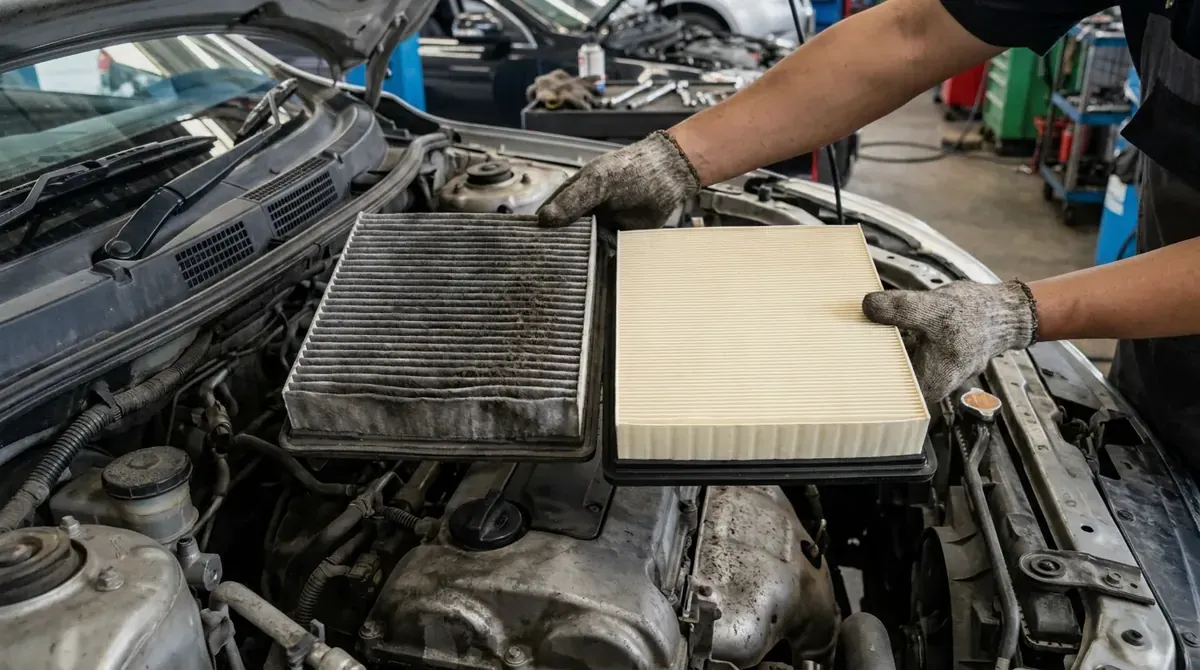
- Engine air filter. SmogTips says it is the emissions part people forget most. When it is dirty, airflow drops and the air and fuel balance is upset. Replace it on your car's recommended schedule, usually about every 15,000 miles, or at least before an emissions test.
- Oxygen sensor. Found in the exhaust, it measures the oxygen remaining after combustion. The engine computer uses that signal to set fuel delivery. If the sensor is worn, it can send a false signal, and the computer may supply fuel the engine does not need. A new one is common and fairly affordable.
- Catalytic converter. This exhaust part cleans the gases before they reach the tailpipe. Damage or clogging lets more emissions pass. It is the priciest item here.
What a high CO repair can cost
These are RepairPal's published averages, so your local shop may quote a little more or less.
| Work item | Typical price |
|---|---|
| Emissions diagnostic check | $61–$90 |
| Engine air filter replacement | $79–$99 |
| Oxygen sensor replacement | $440–$523 |
| Catalytic converter replacement | $2,280–$2,480 |
Because the test result alone can't name the bad part, a diagnostic check before you buy anything can save you from paying for parts you didn't need.
Repair waivers after another failed test
If repairs don't get your car to pass, some states offer a waiver once you've spent a set amount on emissions repairs. How much you must spend, who qualifies and how long it lasts depend on where you live. Spending that amount by itself is not enough: proper receipts are needed, and some states also ask for a failed retest. These are 2026 limits for several states.
| State | Repair spend required first |
|---|---|
| Arizona | All recommended repairs done, up to $450 in the Phoenix area or $300 in the Tucson area; one waiver only, and none for a catalytic converter failure |
| Ohio | $450 for repairs and diagnosis |
| Texas | $600, or $450 for El Paso County |
| Colorado | $715 in documented repair bills, plus another failed test |
| Georgia | $1,176 |
Colorado's DMV lets oxygen-sensor and catalytic-converter work count toward that total. Hoses, gaskets, and clamps tied to the repair count too. Labor counts only when done by a professional mechanic at a licensed business, so save each receipt. A Colorado waiver covers one emissions cycle.
Two of these states draw a line at the catalytic converter: Colorado won't grant a waiver if the converter is missing or tampered with, and Arizona won't grant one for a converter failure.
Questions people ask
What other sensors can push CO up?
Three other engine sensors can add fuel the engine does not need. A faulty throttle position sensor most often causes high CO, because the engine computer errs on the side of adding fuel. If the MAP sensor fails, the computer falls back on preset settings, which may raise CO. A faulty coolant temperature sensor can fool the computer into treating the engine as cold, and a cold engine gets a richer mix.
What does high NOx on the same report mean?
High NOx (nitrogen oxides) means the engine is burning too hot, and its causes differ from those of high CO, though a faulty catalytic converter can play a part in either. The EGR valve and the catalytic converter are the first places to look. Cleaning carbon from the EGR valve and its passages is a smart first step; a new EGR valve averages $489 to $632.
Will the retest be free after repairs?
That varies by state:
| State | Free retest rule |
|---|---|
| Arizona | One retest at no cost within 60 days |
| Georgia | One retest at no cost, same station, within 30 days |
| Pennsylvania | One re-inspection at no cost, same station, within 30 days |
| Ohio | As many as 3 tests at no cost within 365 days |
| Oregon | Nothing to pay if the car does not pass |