Emissions Test Failed: Find the Cause
Tap what your inspection report says failed, or type the trouble code from it, to see the likely cause and a typical repair cost.
A failed emissions test can feel bigger than it is. The slip from the station names the clue, and common causes include a gas cap that will not seal, a clogged air filter, old spark plugs, a vacuum leak, a weak oxygen sensor, or an EGR valve that is stuck. The code or reading on that slip tells you where to start.
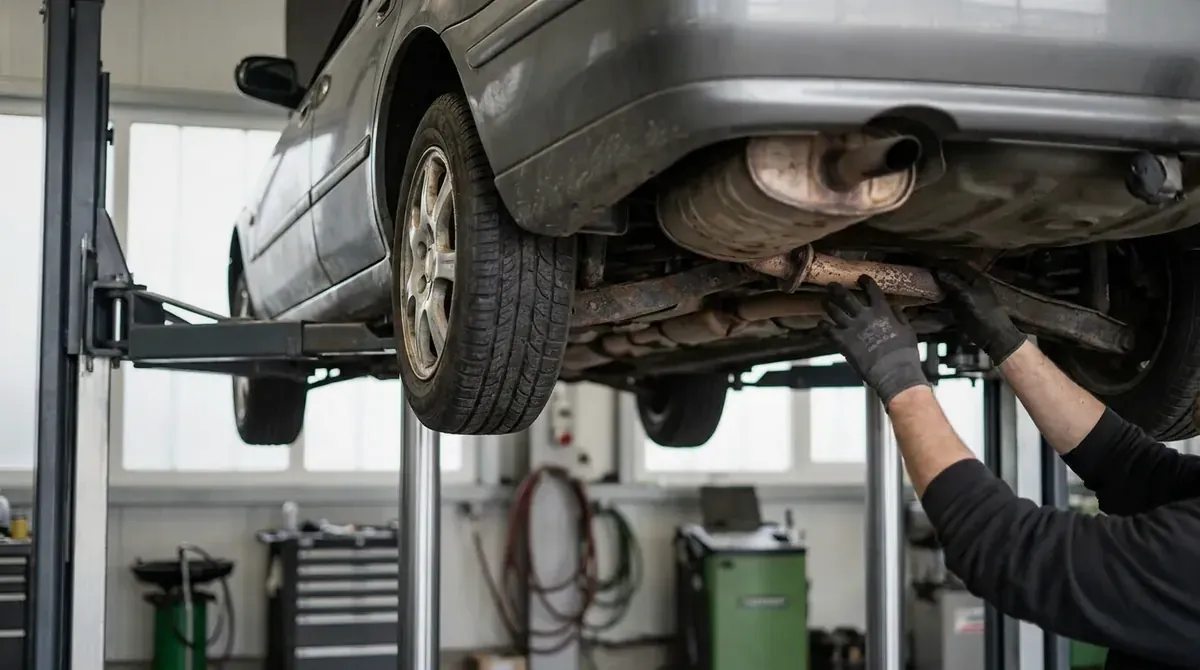
Why cars fail and what the report tells you
Many testing programs use a plug-in check of the car's on-board computer (an OBD check) for 1996 and newer gas cars, but the test depends on your state, model year and fuel type. The station connects to the car computer and reads what it saved. If the check engine light is on, that alone fails the OBD check, and the printout shows the trouble codes that set it. Each code is a short tag, like P0420, pointing to the system the car believes is wrong.
Look at the gas cap before anything else, since a loose cap can turn the check engine light on by itself. Tighten it until it clicks, then keep driving until the light turns off, as Georgia's Clean Air Force explains.
Some reports say "monitors not ready" rather than naming a fault. Readiness monitors are the car's own self-tests, and they can stay incomplete after a battery swap, recent work, or cleared codes. That usually doesn't mean anything is broken. The car just needs more driving, and if it has gone fewer than about 200 miles since the battery change or cleared codes, the self-tests probably haven't finished yet. Most states follow EPA guidance allowing two unfinished self-tests on 1996 to 2000 cars and one on 2001 and newer cars, but your state's rules may differ, and California has stricter limits.
With older cars, the station samples the tailpipe and the report gives readings. High hydrocarbons point to fuel that did not burn, often from aging ignition components, a leak in a vacuum line, or an EGR valve that stays open. High carbon monoxide points to too much fuel for the air; the air filter is the cause people miss most, with the oxygen sensor next. High nitrogen oxides mean the engine is burning too hot; look at the EGR valve first, and the catalytic converter after that.
Codes you will see most, and what they usually point to:
- P0420 or P0430: the catalytic converter is worn out, though an oxygen sensor or an exhaust leak can also set it
- P0442 or P0455: fuel vapor is escaping, and the gas cap is the usual culprit
- P0401: carbon buildup blocking the EGR valve
- P0171 or P0174: start by hunting for a vacuum leak, and if none turns up, the mass airflow sensor may simply be dirty
- P0301 to P0308: the engine is misfiring, most often because of worn spark plugs or a failing ignition coil
Repair costs by part
These figures are published averages, so a nearby shop may quote higher or lower. Rule out the low-cost possibilities before anyone buys a pricey part.
| Part | Typical cost |
|---|---|
| Gas cap, the part on its own | $10–$60 |
| Gas cap, fitted by a shop (with diagnosis and labor) | $138–$150 |
| Engine air filter | $79–$99 |
| Cracked vacuum hose | $100–$250 |
| Ignition coil | $238–$320 |
| Mass airflow sensor | $274–$381 |
| Spark plugs | $288–$399 |
| EVAP purge valve | $323–$380 |
| Oxygen sensor | $440–$523 |
| EGR valve | $489–$632 |
| Catalytic converter | $2,280–$2,480 |
Before paying for one of these parts, try the cheap step first:
- Gas cap: Tighten the cap until it clicks, then drive until the light turns off
- Mass airflow sensor: Clean the sensor and its lines
- EGR valve: Clear carbon from the valve and its passages
- Catalytic converter: Inspect the oxygen sensor and search for exhaust leaks
What to do once your car fails
- Go over the printout with care. It lists the trouble codes, so the mechanic begins with a named system rather than a guess.
- Handle the cheap fixes first. A cap that will not snap shut or a grimy air filter is cheap to put right.
- Check warranty coverage before you pay. Federal rules cover emissions parts on 1995 and newer cars for a minimum of 2 years or 24,000 miles; the on-board computer and the catalytic converter carry 8 years or 80,000 miles of coverage, according to Wisconsin's inspection program.
- If you still don't know the cause, pay for a mechanic's diagnosis. Georgia's Clean Air Force puts it at $60 to $100, and it can keep you from paying for a part you didn't need.
- Put miles on the car ahead of the retest. Maryland wants you to drive for 1 week after repairs so the self-checks can finish.
- Come back inside your state's free retest period. In Georgia, returning to the same station within 30 days gets you one retest at no charge.
Waivers for cars that still fail after repairs
A waiver is for a car that still cannot pass even after genuine repair work; it excuses the car from passing for a set time. Before paying for repairs, check your state's spending requirement, whether the work must be done by a recognized technician, and whether you need another failed test.
| State | Repairs needed for a waiver |
|---|---|
| Maryland | At least $450 |
| Ohio | At least $450, diagnosis included |
| New York | At least $450 |
| Texas | At least $600 ($450 in El Paso County) |
| Colorado | $715 spent within 6 months |
| Georgia | At least $1,176 |
| Illinois | At least $1,176, with the repairs performed by a technician the state recognizes |
| Wisconsin | $1,176, a figure that is adjusted each year |
| Washington, D.C. | $1,208, with the work done by a certified mechanic |
No waiver excuses a missing or tampered part; it must be put back. Colorado's rules also turn down waivers when a car smokes or the failure is just a gas cap.
California takes another path. Its repair assistance program can cover as much as $1,450 of emissions repair costs for cars from 1996 on.
Common questions
How much does a Maryland retest cost?
In Maryland, the first re-inspection is free and each one after that costs $30, according to the Maryland MVA guide. Getting the real fix done before you go back saves you paying again and again.
How long do I have to fix my car in Connecticut?
A failed car has 60 calendar days from the first test to be fixed and retested. That retest is free during the window, and a $20 late fee starts after it. If work at a Certified Emissions Repair Facility reaches $1,137 without the car passing, a waiver may be possible.
What happens after a second or third failed emissions test?
The answer varies by state. Ohio lets you test free of charge three times within a 365-day span, then bills $18 for each one beyond that. In North Carolina, a waiver becomes available once you have $200 in documented repair bills and the car has failed its OBD test a second time. Delaware asks for three failed exhaust tests along with repair spending above its cost ceiling before granting one.
Can the station retest a car with monitors not ready?
Wisconsin will not retest a 2001 or newer car when more than a single monitor remains unset. California has its own rules: gas cars from 1996 to 1999 may pass with any one monitor unfinished, but on 2000 and newer gas cars only the fuel-vapor (EVAP) monitor is allowed to be unfinished.