DPF Cleaner
A DPF cleaner is a product made to help get soot out of the filter in a diesel car's exhaust. Before you buy one, it helps to know the filter’s job, the way it usually cleans itself, and what a diesel emissions check looks for.
What a DPF does
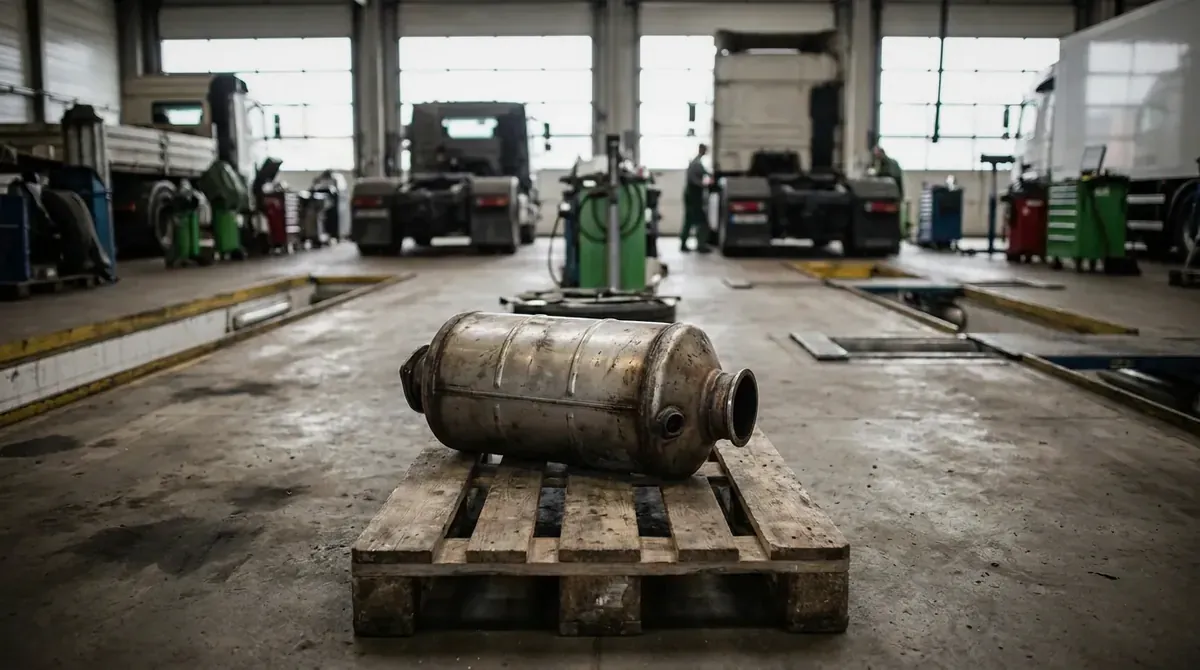
A DPF, short for diesel particulate filter, is part of a diesel engine’s exhaust path. Its job is to catch soot and ash before they leave with the exhaust. The gases flow through, while soot and other tiny solid particles get caught.
Bit by bit, that soot collects inside the filter. If nothing were done, it would clog the filter, so diesels are built to handle it while they drive.
What a bottle of cleaner actually does
A liquid DPF cleaner may help lower the temperature needed to burn off trapped soot, according to supplier rep.direct.
That burn-off is called regeneration. It is how the car cleans the filter on its own, and a cleaner is supposed to help regeneration happen more easily.
How to clean a DPF
There are two ways the filter gets cleaned: the car does it itself while you drive, or a shop does it for you.
- On its own. A diesel is built to clear away collected soot through regeneration, so the filter does not plug up.
- At a shop. A technician heats the filter in an oven, and the high heat loosens hardened deposits so they come off more easily during the last cleaning pass.
Are emissions tests required for diesel cars?
It depends on where your car is registered. In 2026, 27 states and Washington, D.C. test emissions in some or all of their areas, and many of them test diesels too.
| State | Diesel testing area | Diesel rule |
|---|---|---|
| Arizona | Phoenix and Tucson metro areas | Most diesels receive a smoke test |
| California | 34 counties | Diesels get no new-car exemption |
| Colorado | 9 counties | The newest 4 diesel model years are exempt |
| Delaware | Statewide | 1997-and-newer diesels get an OBD plug-in test; older ones get an idle tailpipe test |
| Massachusetts | Statewide | OBD plug-in test, or a smoke test for heavy diesels lacking OBD |
| New York | Statewide | OBD plug-in test, with gas-cap and emissions-parts checks |
| Ohio | 7 counties | OBD plug-in test |
Diesels are also tested statewide in Connecticut, New Jersey, Rhode Island and Vermont, and in parts of Nevada, Missouri, Oregon, Utah, Virginia and Wisconsin.
An OBD test checks the car’s onboard diagnostic system. A check engine light with a stored trouble code means a failed test, so the underlying problem needs to be found and fixed.
Preparing a diesel for inspection day
Readiness monitors are checks the vehicle performs on its emissions equipment as it is driven. After a battery disconnection, recent servicing or cleared codes, the car’s emissions self-checks may not be finished, and some states allow a limited number of unfinished checks.
- Make sure the check engine light is off. If it is on, the car fails the OBD test.
- After a battery change or cleared codes, the car’s self-checks are usually not finished until you have driven about 200 miles.
- Tighten the fuel cap until it clicks. In states that test the cap, a loose or missing one fails.
- Ask the station, or use your own scan tool, to see how many of these self-checks are still unfinished.
In most states, EPA guidance is the yardstick: one incomplete monitor is allowed on a 2001-or-newer vehicle, and two are allowed on a 1996-to-2000 vehicle. California sets a tighter rule for aging diesels: from model years 1998 through 2006, none may be left incomplete.
Questions people ask
Is DPF cleaner effective?
An additive may help the filter burn off soot at a lower temperature, which can make regeneration easier. A bottle of cleaner alone will not get a car with a check engine light through the test: the fault behind the light still has to be fixed.
What are the clues that a DPF needs cleaning?
If your check engine light comes on, the car has stored a trouble code that points to the problem. A shop can read it for you, and RepairPal says an emissions diagnosis usually costs $61 to $90. One warning sign a mechanic looks for is soot on the outlet side of the filter. That side should stay clean, so soot there means something has gone wrong.
If the DPF never gets cleaned, what then?
Putting off DPF cleaning can mean steeper upkeep bills, surprise downtime, and possibly paying for a brand-new filter.
If I clean the DPF on my own, can I still qualify for a waiver?
Whether your own cleaning work counts depends on your state’s waiver rules, so check the official program page before spending money. Ohio’s waiver begins at $450 in emissions repairs and diagnosis; Wisconsin’s begins at $1,176 at an approved facility. Colorado does not allow a waiver for a vehicle that is smoking.