
Catalytic Converter Cleaner
A catalytic converter cleaner helps you pass only when a light carbon clog is the cause; a melted, cracked or coated converter needs replacing. You add it to the fuel in your tank, and it does its work while the car is driven. Your catalytic converter sits in the exhaust and scrubs the fumes on their way out.
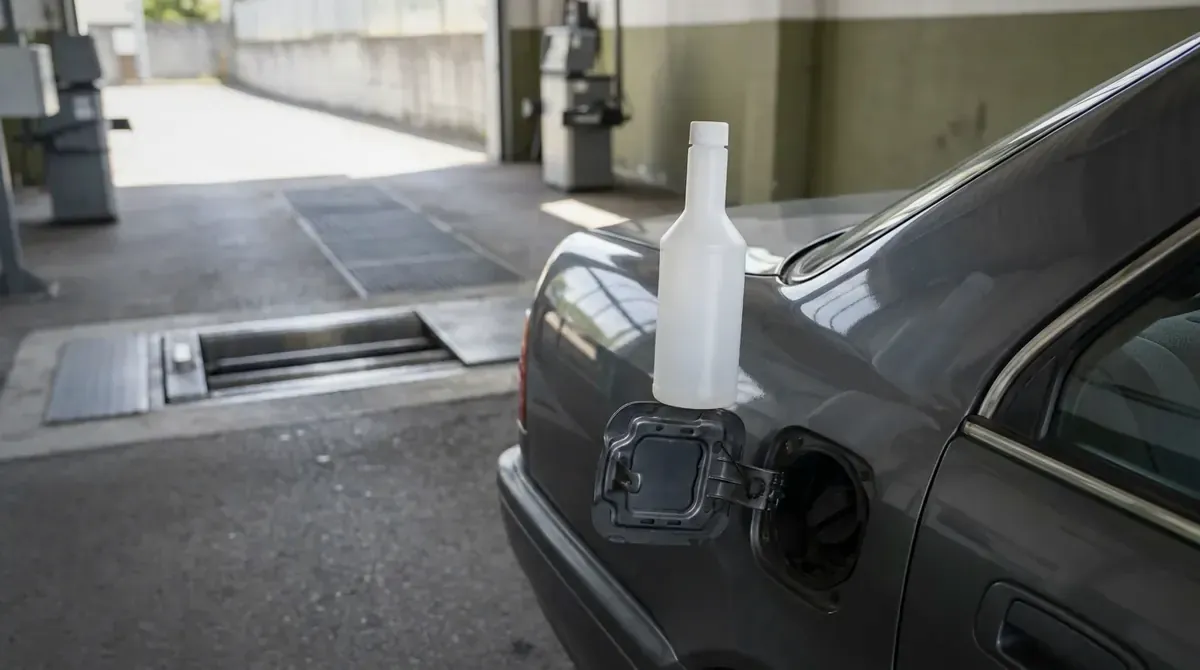
Does catalytic converter cleaner work?
Your two steps: try one bottle over a full tank of driving. If the check engine light is still on after that, a shop has to find the cause.
The cleaner works when carbon is the only thing in the converter's way. Once the check engine light is on, the car's computer stores a short trouble code describing what it detected. CRC, which makes one cleaner of this kind, says its product clears light to moderate clogs. It can sometimes make P0420 and P0430 go away; those codes mean the converter is not cleaning exhaust well enough.
The computer checks the converter through oxygen sensors, small exhaust parts that measure the gases flowing by. You'll usually see results within 1 to 3 driving cycles when the cleaner works. A driving cycle means one trip begun from a cold start, with both town streets and highway in it.
These problems are beyond what a cleaner can fix:
- a converter coated by burning oil, leaking coolant, silicone, or lead (the coat is permanent)
- insides that melted after misfires overheated the converter with fuel that had not burned
- cracks in a converter, or interior parts that are broken
Any of these means the converter needs replacing. Looking at the converter won't tell you which it is. If a full tank with the cleaner changes nothing, let a shop diagnose it.
Picking the cleaner that fits your case
No single brand is best: what caused the trouble matters more than the label. Cleaners target carbon only, and they do the most good when used early, while the converter is still sound.
Choose a brand people know, and do exactly what its directions say. A dealer service team also recommends one bottle at 5,000 to 7,500 mile intervals to keep carbon from building up.
Putting in cleaner ahead of testing
Begin about a week ahead, since the directions call for more than one full tank of driving before the test. CRC's method has several steps; each gives the cleaner time to move through the engine and exhaust:
- Start with a tank about half full, then pour in the whole bottle.
- Do 20 to 40 miles of everyday driving.
- Fill the tank right up, then drive until it is nearly empty.
- Refuel. Check that the check engine light is off and the self-checks below are done, then go to the test.
At the station, the inspector connects to OBD (on-board diagnostics), the computer found in every car built since 1996. It looks at the readiness monitors, the self-checks a car runs on its own pollution parts. That driving also gives these checks time to finish. Resist clearing the code on your own right before testing; it wipes those checks, and you'd need roughly 200 more miles. Most states allow 1 unfinished check on a 2001 or newer car, and 2 on a 1996 to 2000 car. Before you go, a code reader or a shop can tell you whether they're done.
Getting through emissions testing with converter problems
A cleaner takes off carbon; it cannot fix a broken part. When the converter really is failing, work in this order:
- Track down the real cause first. P0420 can also trace back to an exhaust leak or a failing oxygen sensor. Expect to pay about $61 to $90 for a shop diagnosis, far less than the converter itself.
- Get any misfire fixed. With a misfire, raw fuel lands in the exhaust, burns there and can wreck even a brand-new converter.
- Replace a damaged converter. Cleaning won't save a melted or broken one.
- Find out if a repair waiver is possible. After the required emissions-repair spending, many states let a still-failing car stay registered for a while without passing.
The amount you must spend before a waiver depends on your state:
- Ohio: $450
- New York: $450
- Colorado: $715
- Georgia: $1,176
On top of the amount, states set their own conditions. Arizona offers no waiver when a catalytic converter fails. If a converter is missing or tampered with, it fails the parts check, no waiver applies, and it has to be put back.
What does a new converter cost?
The price depends on your car. These are published estimates, and a local shop may charge more or less:
| What you pay for | Usual price |
|---|---|
| Diagnosis at a shop | $61 to $90 |
| A new oxygen sensor | $440 to $523 |
| A new converter, car | $900 to $2,500 |
| A new converter, SUV or truck | $1,500 to $3,500 |
The converter prices come from CRC's guide. RepairPal gives an average of $2,280 to $2,480 for replacing a converter.
Common questions about converter cleaners
What are the signs of a clogged catalytic converter?
AutoZone names three signs: lower gas mileage, dark exhaust smoke, and a rotten-egg smell. If you notice even one, have the converter checked.
Is it okay to add catalytic converter cleaner to a full tank?
CRC's directions call for a tank about half full, not a full one, when you add it.
Is hand-cleaning possible for a badly clogged converter?
A mechanic can remove and clean a heavily clogged converter. The job costs more in labor, and broken or melted insides can't be saved that way; a new converter is then the only fix.
What is the usual life of a catalytic converter?
Most last about 100,000 miles, and many go longer. Once the converter is known to be the problem, act soon. Waiting raises the chance that a clog becomes damage only a new converter can repair.