
Failed Emissions for High HC
If your car failed emissions for high HC, it had too much unburned gasoline detected in its exhaust during the tailpipe test. HC means hydrocarbons, and on that kind of reading it basically means raw fuel. Almost always, that means some of the fuel isn't catching fire properly inside the engine, so it leaves through the tailpipe instead.
What a high HC failure is telling you
Poor fuel ignition is behind nearly every high HC failure, according to SmogTips. When fuel goes unburned in the engine, it travels right out the exhaust, and the testing equipment registers it.
That gives you a good place to start. Check the parts that make the spark first, then anything that throws off the mix of air and fuel.
Making sense of the HC figure on your report
Most reports list HC in parts per million (ppm). The lower the number, the better. For context, Clean Air Car Check lists an HC reading below 100 parts per million as typical of a good-running engine, not as a passing limit for every test.
The report might also flag CO or NOx. If it does, Clean Air Car Check recommends fixing HC and CO before NOx.
Which parts usually cause high HC?
A high HC reading usually traces back to something on this list:
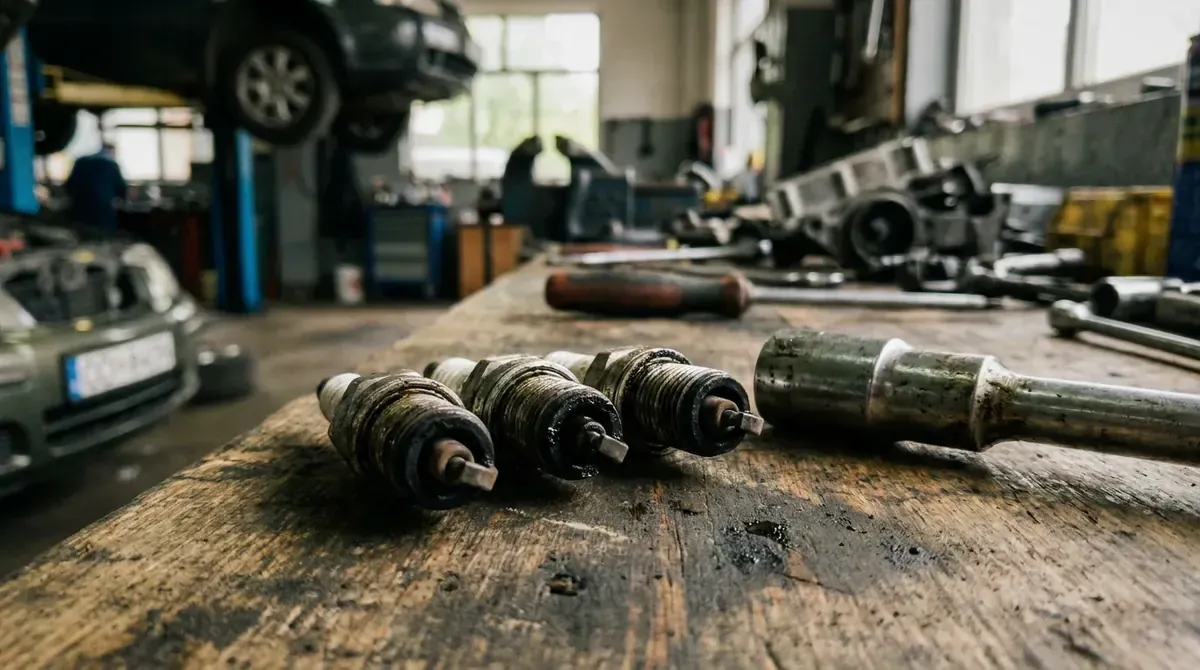
- Ignition components that are worn or failing. Plugs, coils, plug wires, and distributor pieces can each be responsible. Carbon build-up often makes these parts stop doing their job.
- Vacuum and gasket leaks. Extra air gets in, so there is too little fuel for the air. This can make a cylinder fail to fire its fuel.
- Vacuum hoses that are broken, disconnected, or routed the wrong way. These also let in too much air.
- A bad component that operates on engine vacuum, like the power brake booster. It can produce a big vacuum leak.
- Too much fuel. When the engine gets more fuel than it can burn, the extra goes out the exhaust unburned.
- Restricted or plugged fuel injectors.
- An EGR valve stuck open. You will see HC spike as the car decelerates.
- A defective catalytic converter. This one can push HC, CO, and NOx up together.
- A bad smog pump or air injection system.
- Weak cylinder compression. Among the rarer causes. A wet/dry compression test is how a shop checks it.
Ignition timing also counts on older cars that have a distributor. California permits timing to be off by as much as 3 degrees from the manufacturer's setting, and incorrect timing pushes HC up. Late-model engines with no distributor require no timing service.
How to tell the catalytic converter is at fault
A sulfur or rotten-egg odor coming from the exhaust points to a failing catalytic converter. If power drops off sharply somewhere above 15 to 25 mph, the converter may be plugged.
Checking the converter with an exhaust gas analyzer gives the most reliable answer. Since the converter costs more than any other repair here, it pays to be sure of the diagnosis before swapping it out.
What do the repairs cost?
These figures are published averages, and quotes from a local shop may run higher or lower.
| Job | Typical price |
|---|---|
| Diagnostic check for emissions | $61–$90 |
| Replacing a cracked vacuum hose | $100–$250 |
| Replacing an ignition coil | $238–$320 |
| Replacing spark plugs | $288–$399 |
| Replacing an EGR valve | $489–$632 |
| Replacing the catalytic converter | $2,280–$2,480 |
The vacuum hose number is from Irish Mike's Automotive. RepairPal is the source for the rest.
Questions people ask
Will a trouble code identify the cause?
A trouble code can point to a problem, but it does not necessarily identify which part needs replacing. P0301 through P0308 point to a misfire, often from worn spark plugs or a failing ignition coil. P0171 and P0174 mean the engine is getting too much air for its fuel. A vacuum leak is the most common reason, with a dirty or faulty mass airflow sensor next in line.
Can I do anything before replacing parts?
You can clean two parts first. The EGR valve and its tubes can have carbon cleaned out, and you can clean the mass airflow sensor and its lines too. It is worth a try, though cleaning will not solve every high HC failure.
What else could a shop look at?
A technician can use the gas analyzer to test the engine oil for too many hydrocarbons.
What if I cannot afford the repair?
Some states offer a repair waiver if your car still fails after qualifying repairs, but spending the minimum does not guarantee approval. Ohio, New York, and Maryland each put that amount at $450, though every state applies its own conditions.