
EGR Valve Cleaner
An EGR valve cleaner spray dissolves deposits in the EGR valve, the air intake and the inlet valves. For mild symptoms it may help, though a valve that is heavily clogged will usually need to be taken out and cleaned by hand, or swapped for a new one.
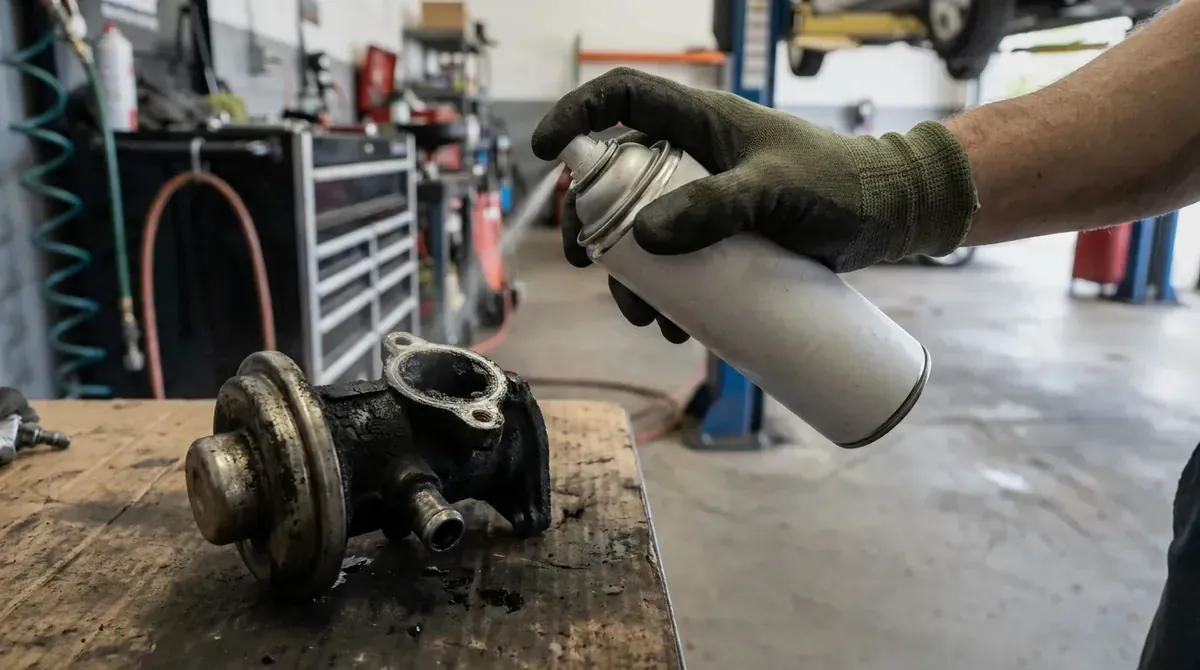
Why the EGR valve clogs
This valve routes some of the exhaust gas back into the engine's intake. Doing this reduces NOx, short for nitrogen oxides, which is a pollutant created when the engine burns at very high temperatures.
Recirculating exhaust helps the vehicle pass emissions rules, but it also pulls soot and particles into the intake. Those gases carry carbon, oil, and leftover combustion residue, which gradually coat the valve until it has trouble opening and closing. In diesel engines, this valve is among the parts most prone to carbon trouble, especially with lots of stop-and-go city driving.
Signs of a clogged EGR valve
The clues tend to appear in everyday driving and at the fuel pump:
- Power drops
- Fuel use climbs and mileage falls
- Rough running or jerking
- Dark smoke from the tailpipe
- Warning messages from the engine computer
Valvoline also notes that carbon on the valve can lead to excess emissions. Jerking, a small drop in power, and black smoke are the lighter symptoms that cleaning without removing the valve may fix.
Spraying cleaner into the EGR system
Valvoline labels its EGR cleaner spray for professional use only, so this treatment is a job for a mechanic rather than a home cleaning method. Check the owner's manual and the product information sheet before you start. Valvoline's method goes like this:
- Disconnect the hose at the intake, or unplug the turbo pressure sensor, then keep the revs steady near 2,000 RPM.
- Mist the cleaner into the air intake manifold in 5-second bursts.
- Repeat those short bursts until the engine settles and runs evenly.
- Put everything back, then drive for about 10 minutes to see how the car behaves.
Will a cleaner fix a badly clogged valve?
Often it won't. A cleaner works best as light or preventive upkeep, and heavy buildup usually needs more than an additive can do.
A fully blocked valve must come off for hand cleaning, or be swapped out. Revving the engine hard won't loosen a stuck valve or break apart hardened carbon.
Cleaning versus replacing the valve
RepairPal recommends cleaning the carbon from the valve and its tubes before you spend money on a new valve. These numbers are published averages, so a nearby shop might quote higher or lower.
If you're not sure the EGR valve is the problem, an emissions diagnosis usually costs $61 to $90 on average.
If cleaning doesn't do the trick, a new EGR valve costs about $489 to $632 on average, according to RepairPal.
Could a clogged EGR valve cause an emissions test failure?
Yes, it can. In most testing states, the inspection plugs into the car's computer, and a check engine light that is on, with a stored trouble code, means a fail. A trouble code is a brief label the car saves for the part or system that has a problem, and the EGR valve is a common culprit.
P0401 is the car's way of reporting that too little exhaust gas is being recirculated. AutoZone says carbon buildup in the valve or its tubes is the usual reason. During a tailpipe test, a valve that isn't working well can appear as high NOx, and a valve stuck open can push up the unburned fuel in the exhaust.
After a cleaning, clearing the code also resets the car's self-tests. If the car has driven fewer than about 200 miles since then, those self-tests usually aren't complete, and the car may not be ready for testing.
Common questions
Is EGR valve cleaner okay on a diesel?
It can be, but be careful if your diesel has a particulate filter, the part that traps soot from the exhaust. Diesels fitted with this filter can respond poorly to EGR cleaning additives. Afterward, watch for fresh warning messages or jerking.
Can I clean an EGR valve while it stays on the car?
For light deposits, holding the engine steady around 2,000 to 3,000 RPM on a drive may help clear the system. A quick burst of hard revving doesn't do the same job.
What works best for cleaning an EGR valve?
A completely clogged valve needs to come off for hand cleaning or be replaced, since a spray alone is not enough. Before trying to reach the valve, check your owner's manual and the cleaner's product information sheet, since the steps differ from car to car.
Do EGR valve cleaners actually help?
They help most as prevention, before deposits have a chance to harden. If you do a lot of city driving, one parts seller suggests a preventive clean every 10,000 to 15,000 km, because stop-and-go traffic clogs the valve faster.